
Most small businesses still think of “security software” as antivirus: something that scans files, flags known bad ones, and quarantines them. That model made sense a decade ago. It doesn’t stop what actually breaches small businesses today.
Key Takeaways
- Traditional antivirus looks for known-bad files. Modern attacks often use legitimate tools already installed on your computer, so there’s no bad file to catch.
- Managed EDR (Endpoint Detection & Response) watches behavior across your whole environment, not just individual files.
- Small businesses are targeted nearly 4x as often as larger companies, and most don’t have anyone watching for the attacks antivirus misses.
- EDR without a human reviewing alerts is still just a smarter alarm that nobody answers.
Antivirus Was Built for a Different Threat
Signature-based antivirus compares files on your computer against a database of known malware. It’s fast, it’s cheap, and it still catches plenty of low-effort attacks. The problem is what it was never designed to catch: an attacker who never drops a “bad file” at all.
A technique security teams call “living off the land” uses tools already trusted on your system — PowerShell, Windows admin utilities, remote management software — to move through your network, escalate privileges, and stage a ransomware deployment. None of that trips a signature scan, because none of it is inherently malicious software. It’s your own tools, used against you.
What Managed EDR Actually Does Differently
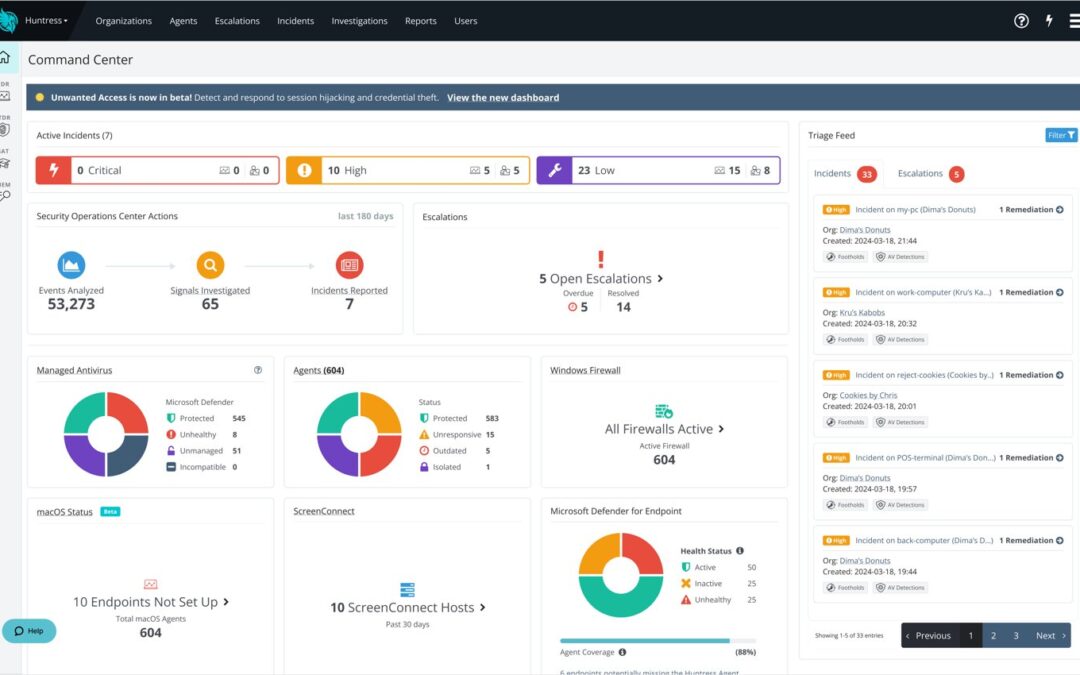
Endpoint Detection & Response flips the question from “is this file bad?” to “is this behavior normal?” It watches process activity, script execution, and network connections across every endpoint, and flags patterns that look like an attack in progress — even when every individual tool involved is legitimate.
- Behavioral monitoring instead of signature matching
- Ransomware canary files that trigger automatic isolation the moment something starts encrypting data it shouldn’t touch
- Rapid isolation to cut off a compromised device before an attacker can move laterally to the next one
- Human-verified alerts — a real analyst reviews suspicious activity instead of leaving it to a dashboard nobody’s watching
That last point matters more than most software comparisons ever mention. A tool that generates an alert at 2 a.m. on a Saturday is only useful if someone actually looks at it before Monday morning.
Why This Matters More for Small Businesses, Not Less
It’s tempting to assume sophisticated, tool-based attacks are an enterprise problem. The data says the opposite: small businesses are targeted nearly four times as often as larger organizations, in large part because attackers know defenses are thinner and nobody’s watching around the clock. A 20-person business with no dedicated IT security staff is often an easier target than a 2,000-person company with a security operations center, even though the eventual ransom demand might be smaller.
Do You Still Need Traditional Antivirus?
In most cases, no. A properly deployed Managed EDR platform replaces the need for a separate antivirus product rather than running alongside it — running both usually just creates conflicts and false positives. If you’re not sure what’s currently installed across your business, that’s exactly what a free risk assessment is for.
FAQ
Does EDR slow down computers the way old antivirus used to?
Modern EDR agents are lightweight compared to legacy antivirus suites, since most of the analysis happens off-device rather than through constant local scanning.
Is EDR only for companies with an IT department?
No — that’s the point of managed EDR. The platform and monitoring are handled by your security provider, so you don’t need in-house security staff to benefit from it.
How does this fit with Humacentric Guardian?
Managed EDR is the first layer of Humacentric Guardian, included in both Guardian Essentials and Guardian Complete.
Book a free risk assessment and we’ll tell you plainly what’s actually protecting your business today — and what isn’t.