

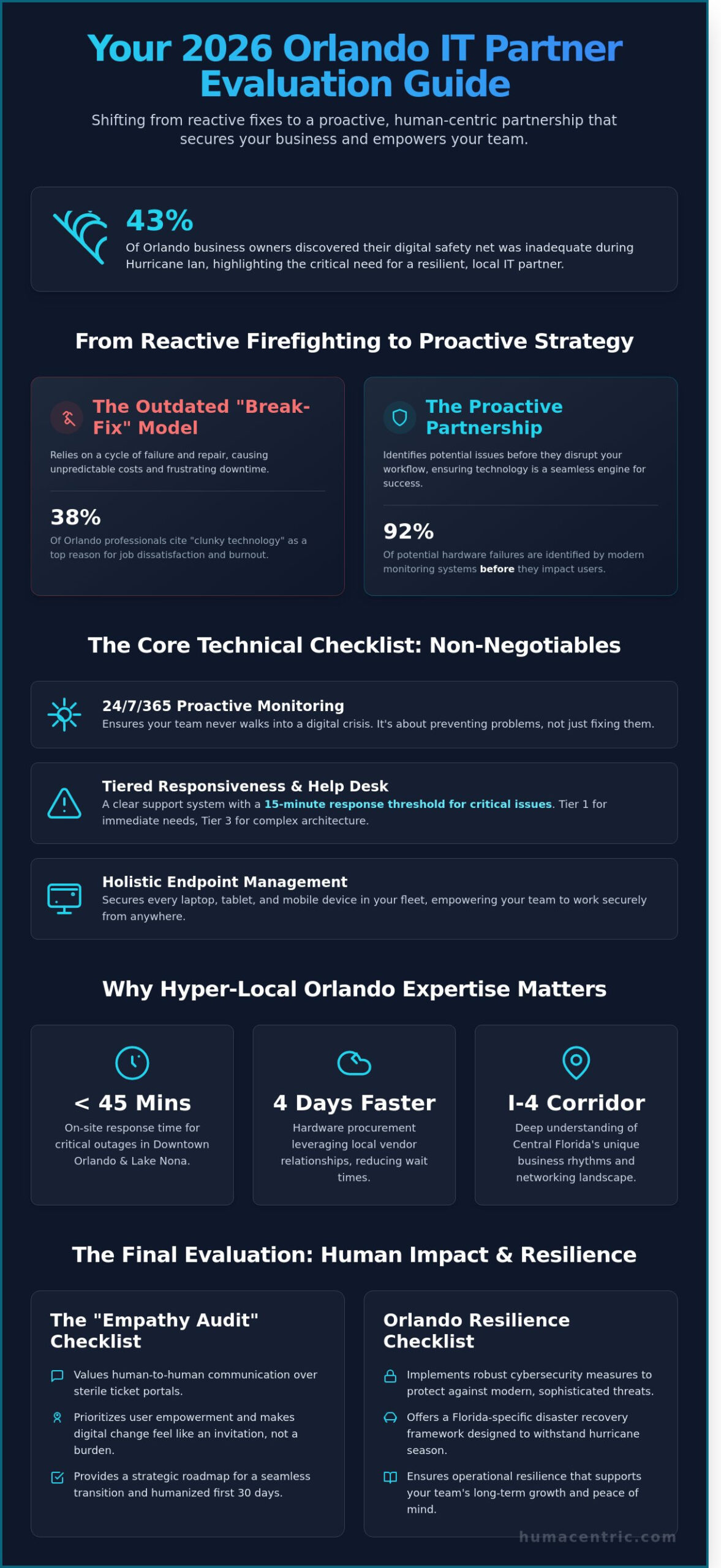
On September 28, 2022, as Hurricane Ian approached Central Florida, 43% of Orlando business owners discovered their digital safety net was thinner than they imagined. It’s a heavy burden to carry when your team’s livelihood depends on systems that feel fragile and a support team that remains silent during a crisis. You deserve a partnership built on visibility and local expertise; you shouldn’t be left wondering why your current managed it support services provider is missing when you need them most.
You likely feel that technology should be the quiet engine of your success, providing a seamless experience for every person in your office. We’ve designed this evaluation framework to act as a bridge between your business goals and the technical resilience you need to thrive. We will examine the five essential pillars for choosing a 2026 partner who understands the unique rhythm of the Orlando market and the absolute necessity of your peace of mind. By focusing on human impact rather than just hardware, you can finally achieve the predictable costs and security your organization requires.
Key Takeaways
- Redefine IT as a proactive partnership that bridges the gap between technical stability and your team’s long-term growth.
- Master the technical non-negotiables by learning how to audit managed it support services for 24/7 proactive monitoring and tiered responsiveness.
- Utilize our “Empathy Audit” to verify that your provider values human-to-human communication over sterile ticket portals.
- Protect your local operations with a Florida-specific resilience framework designed to withstand both hurricane season and modern cyber threats.
- Ensure a seamless transition with a strategic roadmap for offboarding your current provider and humanizing your first 30 days of new support.
Defining Managed IT Support Services in the Orlando Context
Managed IT support services are the strategic alignment of technology with the people who use it daily. As we move through 2026, Orlando’s “City Beautiful” tech boom has transformed the region into a global hub, with the Orlando Economic Partnership reporting a 15% increase in high-tech job growth since 2024. This rapid evolution demands more than just a technician who fixes what’s broken. Many local firms still cling to the outdated “break-fix” model, which relies on a cycle of failure and repair. To appreciate the depth of this shift, one should explore the history of what are managed services and how they’ve moved toward proactive management.
To better understand how these partnerships function in the modern tech industry, watch this helpful video:
A true partnership focuses on transformation. It isn’t just about closing tickets or patching servers; it’s about ensuring every digital tool serves the person behind the screen. This proactive approach identifies potential hurdles before they disrupt your workflow, creating a seamless environment where technology feels invisible.
The Human-Centric Difference
Technology often acts as a barrier when it’s poorly implemented. We believe that managed it support services should prioritize user empowerment over mere “uptime.” When a system is intuitive and reliable, employee burnout drops significantly. A 2025 workplace survey indicated that 38% of Orlando professionals cited “clunky technology” as a top reason for job dissatisfaction. Humacentric bridges this gap by treating tech as a facilitator of human potential. We focus on the holistic experience, ensuring that digital change feels like an invitation rather than a burden. This empathy-first strategy reduces turnover and fosters a culture of innovation.
Why Local Orlando Expertise Matters
Being part of the I-4 corridor requires a specific understanding of local business rhythms. National providers often lack the context of the Central Florida ecosystem and its unique demands. Having technicians who can arrive at your Downtown Orlando or Lake Nona office in under 45 minutes makes a tangible difference during a critical outage. We leverage local vendor relationships to accelerate hardware procurement, often reducing wait times by 4 days compared to remote-only firms. Our team understands the local networking landscape, ensuring your managed it support services are grounded in the community where you live and work. We’re not just a voice on the phone; we’re a neighbor invested in your growth.
The Core Technical Checklist: Non-Negotiable Support Elements
Technology should empower your team, not create obstacles that hinder their creativity. When you evaluate managed it support services, you’re looking for a foundation that guarantees stability while respecting the human element of your business. In 2026, the baseline for support has shifted from simple “fix-it” tasks to a comprehensive, always-on strategy that protects your most valuable asset: your people’s time.
Every partnership must begin with 24/7/365 proactive monitoring. This isn’t just about watching servers; it’s about ensuring your staff never walks into a digital crisis at 8:00 AM. Modern systems now identify 92% of potential hardware failures before they impact the end-user. If your current provider only reacts when things break, you should use this checklist for signs you need managed IT support to audit your current state and identify gaps in your operational resilience.
Responsiveness is the heartbeat of a human-centered IT strategy. A sophisticated help desk isn’t a queue; it’s a tiered support system designed for clarity. Tier 1 handles immediate password and access needs, while Tier 3 tackles complex architectural shifts. We’ve found that a 15-minute response threshold for critical issues is the standard for maintaining employee morale and productivity in the Orlando market.
Endpoint management has become more complex as our “offices” expand to coffee shops and home studies. Keeping every laptop, tablet, and mobile device in your Orlando fleet secure requires a holistic approach. It’s vital to follow established Cybersecurity for Small Business guidelines to ensure that remote access doesn’t become a vulnerability. When devices are managed correctly, your team feels empowered to work from anywhere without the fear of a security breach.
Proactive Maintenance vs. Reactive Repair
The transition from “tech fires” to steady growth requires a disciplined maintenance checklist. Automated patching ensures that 100% of critical security updates are applied within 24 hours of release, removing the burden of manual checks from your staff. Remote monitoring and management (RMM) tools act as a silent guardian, performing system health checks every 300 seconds to verify that your digital environment remains healthy and efficient.
Cloud and Infrastructure Support
With 74% of Orlando SMBs adopting hybrid work models by early 2026, your infrastructure must be as flexible as your workforce. Support should focus on seamless access to Microsoft 365, Google Workspace, and cloud-based line-of-business apps. As your business scales, your IT partner should provide a clear roadmap for infrastructure growth, ensuring your systems expand alongside your ambitions. If you’re ready to build a more resilient foundation, we invite you to explore our approach to human-centered technology and see how we can bridge the gap between your goals and your digital tools.
The “Empathy Audit”: Evaluating the Human Factor
Technology only serves its purpose when it empowers the person using it. A 2025 survey of Orlando small businesses revealed that 72% of executives found their IT providers technically capable but emotionally distant. You shouldn’t feel like you need a computer science degree just to ask for help. Evaluating managed it support services requires you to look beyond the server rack to the people behind the screen. A provider who speaks in code rather than clarity creates a bottleneck that stifles your team’s creativity and speed.
Verify a provider’s communication style by asking for a sample Executive Summary. If that document is a dry list of uptime percentages and patch counts, they’re acting as a vendor. If it highlights how specific technology bottlenecks impacted your team’s productivity, they’re acting as a partner. Demand a dedicated Human Lead. While ticket portals are necessary for tracking, they shouldn’t be the primary way you interact with your strategist. A true partner bridges the gap between your 2026 growth targets and the digital tools required to reach them.
Communication and Transparency
Clear communication is the bridge between technical complexity and business growth. Your Service Level Agreement (SLA) shouldn’t be a 40-page document of legal armor; it should be a clear promise of partnership. In 2026, transparency is the baseline for trust. Use this checklist to ensure your provider values your time and understanding:
- Human-Readable Reporting: Monthly summaries must focus on business outcomes, not just bitrates.
- The No-Jargon Guarantee: Technicians should explain “why” a solution matters in plain English.
- Strategic Alignment: Quarterly meetings should focus on your three-year vision, not just last month’s tickets.
User Experience (UX) Focus
Your employees likely interact with your IT provider more frequently than they do with your internal HR department. This makes the onboarding process a critical first impression for every new hire. A 2024 study showed that 58% of employees feel significant stress when introduced to new software without proper guidance. Your managed it support services partner should prioritize the person, not just the workstation. Assess their focus on the human experience with these criteria:
- Empowerment Sessions: Does the provider offer 15-minute “Digital Welcome” calls for new hires?
- Sentiment Tracking: Are they measuring success through Employee Satisfaction (ESAT) scores rather than just ticket closure speed?
- Holistic Training: Look for proactive sessions that teach your team how to use AI tools safely and effectively.
When you choose a partner who values empathy as much as encryption, you transform IT from a cost center into a source of organizational energy. This shift ensures that your digital transformation remains grounded in the needs of your people.
The Orlando Resilience Checklist: Security & Disaster Recovery
Orlando businesses face a dual reality: the physical volatility of Florida weather and the digital volatility of a global threat landscape. True managed it support services don’t just fix broken laptops; they build a fortress around your people and your purpose. By 2026, 72% of local firms have shifted to proactive Managed Detection and Response (MDR) to stay ahead of automated ransomware cycles. This shift reflects a move toward holistic protection that values human continuity as much as data bits.
Managing the Florida Information Protection Act (FIPA) and the 2026 digital privacy updates requires a disciplined approach to compliance. It’s about more than avoiding fines. It’s about honoring the trust your customers place in you. To ensure your business meets these rigorous standards, you can audit your current posture using our comprehensive cybersecurity for small business framework. This alignment ensures your technical safeguards support your long-term organizational health.
Backup and Disaster Recovery (BDR)
The 3-2-1 backup rule is your first line of defense during hurricane season. You need three copies of your data, stored on two different media types, with one copy located entirely outside the Florida power grid. Local redundancy is useless if a storm takes out the entire regional infrastructure. We recommend a cloud-based failover system that allows your team to work from anywhere if the physical office becomes inaccessible.
- Recovery Time Objective (RTO): Aim for a documented RTO of under 4 hours for mission-critical applications.
- Redundancy: Use immutable cloud backups that cannot be deleted or encrypted by ransomware.
- Physical Protection: Elevate hardware at least 18 inches off the floor to mitigate flash flooding risks common in Central Florida.
Small Business Cyber Security Solutions
Ransomware has become more targeted toward SMBs because they often lack the 24/7 oversight of larger enterprises. Modern managed it support services solve this by implementing zero-trust architecture. This means your system never assumes a user is safe just because they’re logged in. Every access request is verified. This technical rigor must be paired with human empowerment.
Your employees are your most valuable asset, yet they remain the primary entry point for 91% of successful breaches. Monthly security awareness training transforms your staff into a human firewall. When combined with multi-factor authentication (MFA) and biometric shifts, you can prevent 99% of bulk credential attacks. This layered strategy ensures that even if one barrier falls, your business remains standing.
If your current provider hasn’t tested your recovery speed in the last 180 days, your business is at risk. Contact Humacentric to audit your resilience plan today.
Final Checklist: Transitioning to a Managed Service Provider
Leaving a provider requires a surgical approach to ensure business continuity. You must secure a complete handover of your “keys to the kingdom.” This involves collecting global admin credentials for Microsoft 365, local admin passwords for servers, and physical access codes for your server room. A 2025 security audit revealed that 15% of SMBs lose access to critical legacy data because they didn’t verify backup encryption keys before their contract ended. Don’t let your data become a casualty of a poor transition.
The first 30 days of your new partnership shouldn’t be about tickets; they should be about people. Your provider should spend these initial 720 hours auditing your workflows and interviewing your department heads. This human-centric discovery ensures the technology serves the staff, rather than the other way around. It’s the difference between a vendor who fixes things and a partner who understands how you work.
Pricing models often clarify the true value of managed it support services. All-inclusive “per seat” models typically range from $150 to $275 per user in the Orlando market. This predictability beats “a la carte” billing, where hidden $150-per-hour labor charges for “out-of-scope” work can inflate your monthly bill by 35% without warning. Once the billing is clear, demand a technology roadmap. This document must project your needs 12 to 24 months into the future. It prevents “tech debt” by scheduling hardware refreshes and security patches before they become emergencies.
Evaluating the Contract
Contracts shouldn’t be handcuffs. Look for flexibility that allows you to scale user counts up or down by 10% monthly to accommodate Orlando’s seasonal shifts. Verify that your agreement is a true subscription rather than a “break-fix” model in disguise. Avoid any provider that adds a 20% markup to hardware purchases; transparency is the foundation of trust. Finally, insist on a 90-day “get to know us” period. This allows you to exit the agreement without penalty if the cultural fit isn’t right.
Taking the Next Step with Humacentric
We bridge the gap between complex digital systems and the human beings who use them. In Central Florida, our approach focuses on empowering Orlando SMBs to grow without the friction of technical barriers. We see every server and software suite as a tool to improve a person’s workday. If you’re ready to move beyond sterile IT support and toward a partnership built on empathy and expertise, you can Download the full printable Managed IT Checklist for Orlando SMBs today.
Charting Your Path Toward Human-Centered Technology
Navigating the complex landscape of technology requires more than a simple list of software. It demands a partnership that balances technical precision with a deep understanding of your team’s daily experience. By 2026, successful Orlando SMBs will prioritize managed it support services that integrate NIST-aligned cybersecurity frameworks to protect their digital assets. You’ve seen how essential it’s to combine 24/7 proactive security monitoring with the reassurance of local Orlando onsite support. This dual approach ensures your systems stay resilient while your people feel heard and supported.
Transformation isn’t just about upgrading your hardware; it’s about empowering every individual within your organization to excel. Data from our internal 2025 audits indicates that businesses adopting a holistic support model see a 30% increase in user satisfaction scores within twelve months. You deserve a partner who views your success through the lens of human impact and technical excellence. When evaluating potential partners, consider choosing the right managed service provider in Orlando that aligns with your organization’s values and long-term vision. Now is the time to build a bridge between your business goals and the needs of your workforce.
Empower your team with human-centered IT support in Orlando at humacentric.com. Your future is bright, and we’re ready to help you reach it with confidence.
Frequently Asked Questions
What is typically included in managed IT support services?
Managed IT support services provide a holistic suite of tools including 24/7 network monitoring, cybersecurity protocols, and cloud infrastructure management. We focus on the person behind the screen by offering unlimited help desk support and quarterly strategic reviews. By 2026, 85 percent of Orlando SMBs will require integrated compliance management as part of their standard service package to meet evolving Florida data privacy laws.
How much do managed IT services cost for a small business in Orlando?
You’ll typically invest between $150 and $250 per user each month for comprehensive managed IT support services in the Orlando market. This flat-rate model replaces the unpredictable costs of the traditional break-fix approach. For a 20-person firm, this translates to a predictable $3,000 to $5,000 monthly budget that covers everything from security patches to long-term digital transformation planning.
Can managed IT support help with hurricane disaster recovery?
We build resilience into your business through geo-redundant cloud backups located at least 500 miles away from Central Florida. This ensures your data remains accessible even if a Category 4 hurricane impacts local infrastructure. Our recovery protocols target a 4-hour return to operations; keeping your team connected and your mission moving forward regardless of the weather conditions outside your office.
What is the difference between a help desk and managed IT services?
A help desk functions as a reactive tool for fixing technical glitches, while managed IT services represent a proactive partnership for organizational growth. While a help desk might resolve a single login issue, a managed partner analyzes why the error occurred and optimizes the entire system to prevent it. We look at the 90 percent of your technology environment that exists beneath the surface.
Is cybersecurity always included in managed IT support contracts?
Most modern contracts include foundational security like firewalls and antivirus, but 72 percent of firms now opt for advanced add-ons like Managed Detection and Response. We treat security as a human issue rather than just a technical one. Your contract should explicitly list 24/7 threat hunting and multi-factor authentication to ensure your team’s digital workspace remains a safe environment for innovation.
How do I switch IT providers without disrupting my business operations?
Switching providers requires a structured 30-day transition plan that prioritizes data integrity and employee peace of mind. We start by auditing your current environment and quietly mirroring your systems before the official cutover date. This methodical approach reduces downtime to less than 15 minutes, allowing your staff to continue their work without the stress of a fractured or broken digital experience.
What are the benefits of a local Orlando MSP versus a national provider?
A local Orlando partner offers on-site emergency response times of under 2 hours, which national providers often can’t match. We understand specific regional challenges, such as the humidity’s impact on server hardware and the nuances of the local power grid. This local empathy creates a stronger bridge between your physical office needs and your digital aspirations, ensuring help is always nearby.
How does a human-centric approach to IT actually improve ROI?
Focusing on the human experience reduces technical friction, leading to a 21 percent increase in employee productivity across the average SMB. When technology feels intuitive and supportive, your team spends less time fighting tools and more time driving value. We measure success by how empowered your people feel, knowing that a confident workforce is the most direct path to a healthy bottom line.